Our Founding Purpose

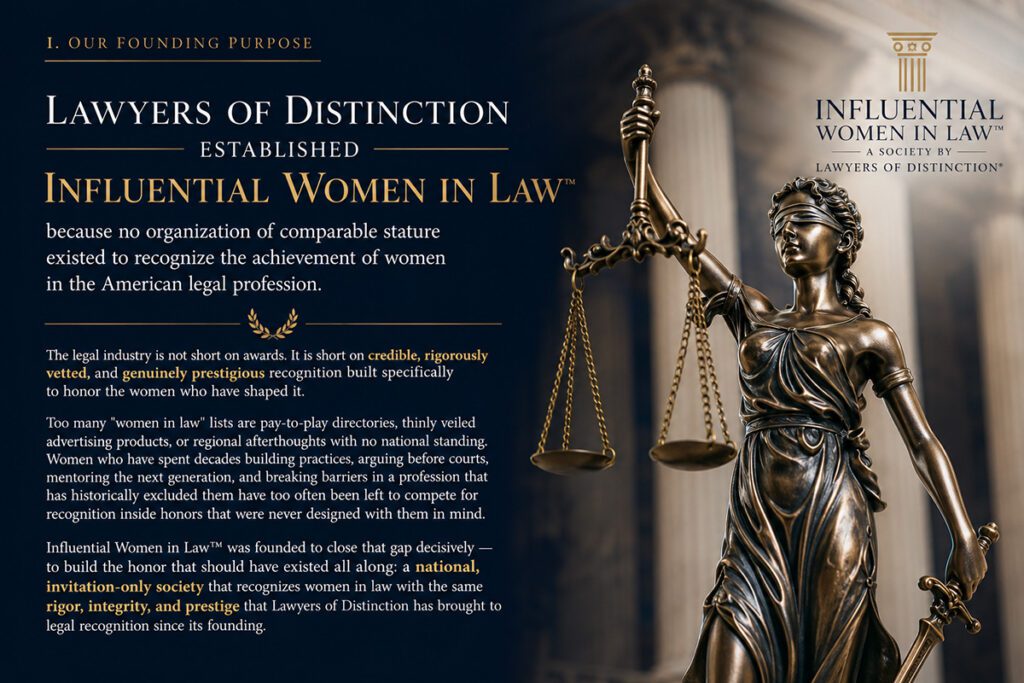
Lawyers of Distinction established Influential Women in Law™ because no organization of comparable stature existed to recognize the achievement of women in the American legal profession.

The legal industry is not short on awards. It is short on credible, rigorously vetted, and genuinely prestigious recognition built specifically to honor the women who have shaped it. Too many “women in law” lists are pay-to-play directories, thinly veiled advertising products, or regional afterthoughts with no national standing. Women who have spent decades building practices, arguing before courts, mentoring the next generation, and breaking barriers in a profession that has historically excluded them have too often been left to compete for recognition inside honors that were never designed with them in mind.

Influential Women in Law™ was founded to close that gap decisively — to build the honor that should have existed all along: a national, invitation-only society that recognizes women in law with the same rigor, integrity, and prestige that Lawyers of Distinction has brought to legal recognition since its founding.


The Case for Recognition — By the Numbers

The need for this honor is not a matter of sentiment. It is a matter of record.

A profession transformed within living memory:


From 1950 to 1970, women made up only 3% of all American lawyers.

That figure rose to 8% by 1980, 20% by 1991, and 27% by 2000.

Today, women comprise 41% of all active U.S. lawyers — up from 36% just a decade ago, in 2014.

There are more than 1.3 million active lawyers in the United States today; women now represent well over half a million of them.

A pipeline built for the future:


Women now make up 56.2% of all law school students nationwide, and that share continues to widen.

In 2023, women became the majority of law firm associates for the first time in American history.

Since 2020, women have held the majority of the roughly 44,000 general lawyer positions across the federal government’s executive branch.

Legal industry analysts have designated 2016–2026 the “Decade of the Female Lawyer,” projecting the profession will approach gender parity by the middle of this decade.

A ceiling that has not yet caught up with the pipeline:


Despite these gains, only 28% of law firm partners are women — a figure that has risen just 8 points in the past ten years.

Only 12% of managing partner roles are held by women.

Just 33% of sitting Article III federal judges are women.

This is the paradox Influential Women in Law™ exists to address: extraordinary, historic advancement in the profession’s ranks, met with a recognition infrastructure that has not caught up. The women succeeding despite that gap — reaching partnership, the bench, general counsel’s office, and the top of their fields — are precisely the women this honor was built to celebrate.


The story of American jurisprudence cannot be fully told without the visionary women who dismantled systemic barriers to reshape the legal landscape. For centuries, women fought not just for the right to practice law, but for the fundamental recognition of their equality under it.

Arabella Mansfield (1846–1911): In 1869, Mansfield became the first female attorney in the United States after challenging an Iowa statute that restricted the bar exam to white males. The court ruled that “the affirmative declaration that male persons may be admitted is not an implied denial to the right of females,” sparking a quiet revolution.


  • Belva Ann Lockwood (1830–1917): A tireless advocate for equal rights, Lockwood became one of the first female attorneys in the District of Columbia. In 1879, she successfully petitioned Congress to pass a law allowing qualified women attorneys to practice before the U.S. Supreme Court, later becoming the first woman to argue a case before the nation’s highest bench.
  • Constance Baker Motley (1921–2005): A towering figure in the Civil Rights Movement, Motley was the first Black woman appointed to the federal judiciary. As a key strategist for the NAACP Legal Defense Fund, she wrote the original complaint in Brown v. Board of Education and won nine out of ten cases she argued before the Supreme Court.
  • Justice Sandra Day O’Connor (1930–2023): Breaking a 191-year glass ceiling, Justice O’Connor was appointed as the first female Supreme Court Justice in 1981. Her pragmatism and dedication to the rule of law made her the pivotal swing vote on the Court for over two decades, permanently cementing the authority of women at the absolute apex of legal power.


“Society as a whole benefits immeasurably from a climate in which all persons, regardless of race or gender, are free to earn respect on the basis of their individual merit.”

— Justice Sandra Day O’Connor


Today, women do not merely occupy space in the legal profession; they define it. From the corridors of the Supreme Court to the boardrooms of the Fortune 100, modern women in law command immense authority, steering the evolution of American democracy and corporate governance.

The presence of leaders like Justices Sonia Sotomayor, Elena Kagan, Amy Coney Barrett, and Ketanji Brown Jackson underscores a vital truth: the interpretation of the Constitution is fundamentally shaped by diverse legal minds.


Our Symbol: The Lady of Justice

Every member of Influential Women in Law™ carries forward the meaning of our chosen emblem — the Lady of Justice — whose imagery has represented the ideals of the law for centuries.


The Scales, held level in one hand, represent fairness — the impartial weighing of every argument, every fact, every party before her.

The Sword, held firm in the other, represents justice — the strength and resolve to enforce what the scales have found to be true.

Her closed or blindfolded eyes represent the discipline of seeing with the heart rather than with prejudice — judgment untainted by identity, wealth, or influence.

The serpent beneath her feet represents the enduring promise that justice ultimately triumphs over evil — that patience, principle, and the rule of law outlast corruption and wrongdoing.

We chose her as our emblem because she is not a symbol of the legal profession as it has been — she is a symbol of the legal profession’s highest aspiration. Every woman inducted into this honor is recognized as someone who embodies these same qualities in her own practice: fairness in her dealings, strength in her advocacy, clarity in her judgment, and an unwavering belief that justice, in the end, prevails.


What This Honor Represents

Induction into Influential Women in Law™ is not a directory listing. It is a recognition — extended by invitation only, following a rigorous and deliberate vetting process — of three qualities that define the finest of the profession:


Integrity — a reputation, built over years of practice, for honesty and principled conduct both inside and outside the courtroom.

Leadership — demonstrated influence within one’s firm, practice area, community, or the profession at large.

Legal Excellence — a body of work and professional achievement that stands among the best in the field.

Membership in Influential Women in Law™ is earned, and it is conferred. It stands, by design, as one of the few national honors created specifically to give women in law the recognition that the numbers above make clear they have long deserved and too rarely received.


The Inaugural Class of 2026

The 2026 Influential Women in Law™ Awards mark the first class of this honor — a distinction that will be remembered as the founding cohort of a society built to last. Those inducted into this inaugural class stand not only as honorees, but as the original standard against which all future members will be measured.

To be named among them is to be recognized, permanently and by name, as one of the women who defined what this honor would come to represent.

Through the Inaugural 2026 Class, we celebrate the legal minds who possess the intellect to dissect the most volatile challenges of our time, the stature to command the highest echelons of respect within the legal community, and the grace to leave the ladder down for those who will inevitably follow. Welcome to a legacy defined by excellence.